

Demystify the meme
Understand why golden-ratio face calculators feel scientific and still mislead.
Myth-bust + measure
Phi overlays are a story. GlowUp measures presentation dimensions that move with habits — and tells you what the ratio memes leave out.
Understand why golden-ratio face calculators feel scientific and still mislead.
Aura Score plus five dimensions beat a single phi percentage.
Balance and proportion questions still matter — answer them with symmetry, structure, and contour.
The golden ratio (about 1.618) shows up in maths and design lore. Beauty content often draws phi grids on celebrity faces and implies attractiveness equals closeness to that grid. Research on facial attractiveness is real; the leap from “some ratios correlate in studies” to “your selfie phi score is destiny” is not. Consumer golden-ratio face tests usually detect landmarks, compute a few proportions, and emit a confident percentage. Different apps disagree on the same photo because the recipe is proprietary and the photo conditions dominate. Treat viral phi tests as entertainment unless they show methodology you can inspect.
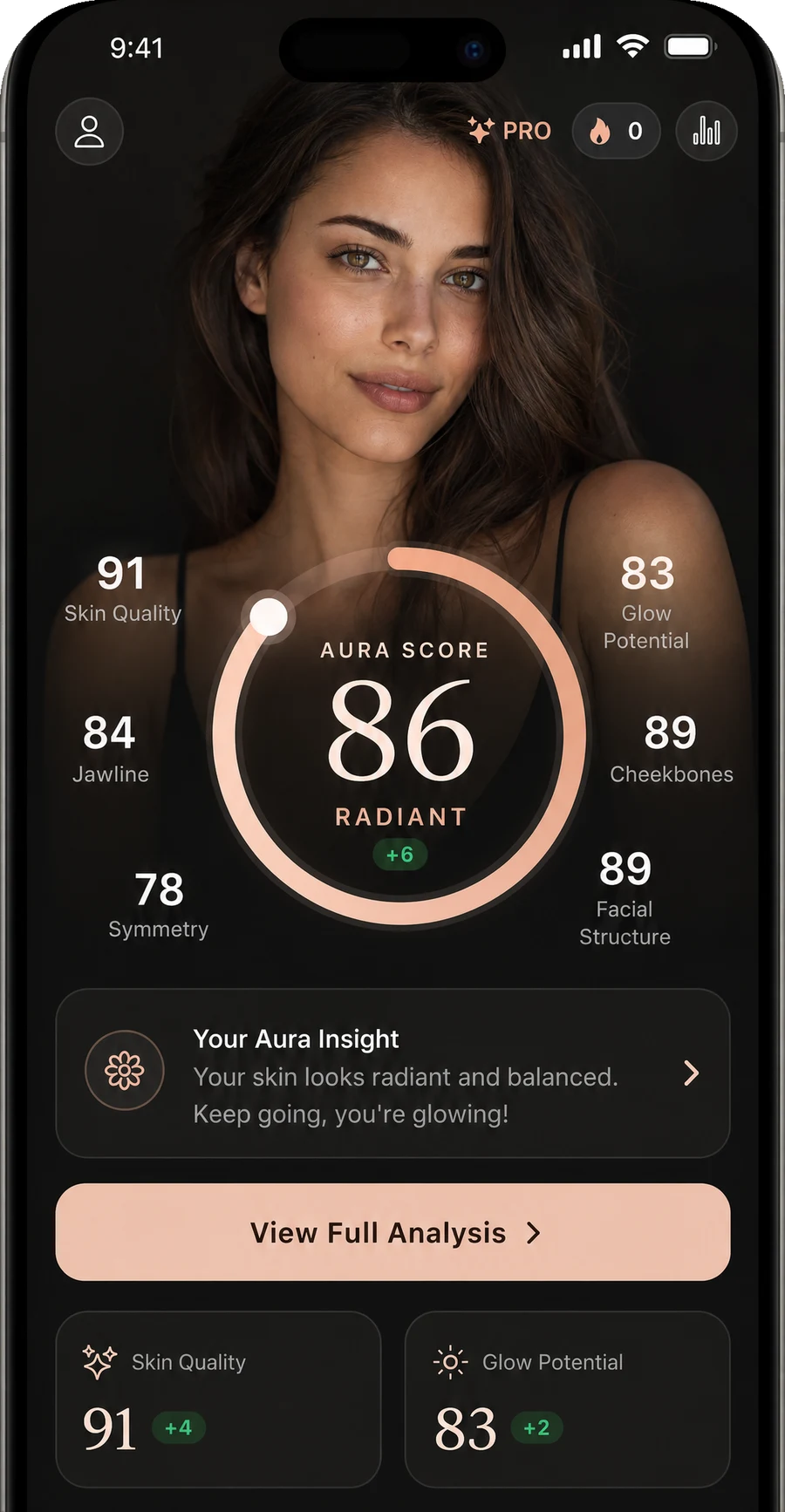
GlowUp does not sell a golden-ratio face score. It returns an Aura Score and Skin Quality, Glow Potential, Contour, Facial Structure, and Symmetry — dimensions tied to a glow-up product loop. Symmetry and structure capture balance and frame; contour captures definition; skin captures the finish that ratio overlays ignore entirely. That last point matters: many phi tests barely discuss skin, sleep, or grooming, yet those change how “perfect” proportions look in real life within weeks. GlowUp’s routine, streaks, and rescans exist because presentation is dynamic.
Read Facial Structure and Symmetry as context, Contour as the trainable definition layer, and Skin Quality as the polish layer. Use ranked improvement areas to pick one project. Ignore the urge to chase a celebrity grid. If a sudden proportion or symmetry change appears in real life — not just in an app — see a clinician. Apps measure photos; they do not replace medical evaluation.
Download GlowUp, take a bare daylight selfie at eye level, read the breakdown, follow the generated routine for a month, rescan. Compare your own history. That experiment teaches you more about your face than any golden-ratio calculator screenshot, because it includes time — the variable phi memes leave out.
No. GlowUp does not output a phi or golden-ratio percentage. It scores multiple presentation dimensions for tracking.
They are inconsistent across apps and sensitive to angle and lighting. Use them as curiosities, not as clinical truth.
A multi-factor scan with a fixed photo protocol and a rescan history — the GlowUp loop.
No. Harmony is a broader idea of balance. See the facial harmony score page for GlowUp’s framing.
Free to start. Scan once, read the six-score breakdown, track what improves.
Free download on iOS and Android.
