

A number is useless without dimensions
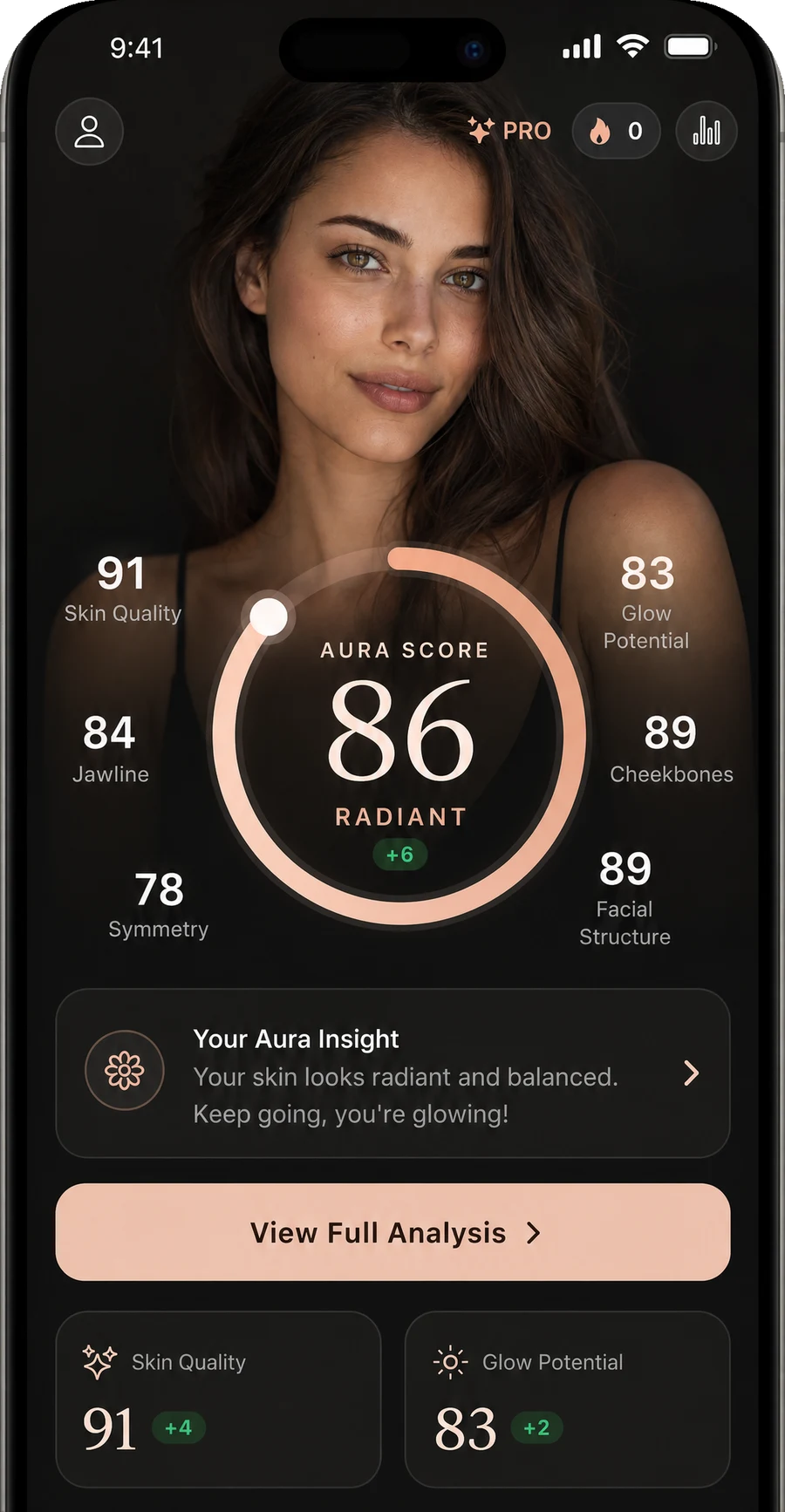
An overall Aura Score plus five category scores, so you know whether skin, symmetry, or contour is the real lever.
AI face scoring
Skip vague 1–10 ratings. GlowUp scores facial structure, contour, symmetry, skin quality, and glow potential — then helps you track what actually improves.
An overall Aura Score plus five category scores, so you know whether skin, symmetry, or contour is the real lever.
Save scans and compare over weeks. Face score apps that only rate once are entertainment; this is a tracker.
A generated AM/PM routine, product ingredient scanning, and an AI Skin Coach turn the result into a plan instead of a dopamine hit.
Most “rate my face” tools spit out a single number with no path forward. That format is designed to be screenshotted, not used. A useful face score app does three things differently. First, it separates the traits you can train — skin quality, grooming, how defined your contour reads — from baseline structure that changes slowly, if at all. Second, it tells you what to do about the weak dimensions rather than leaving you to guess. Third, it makes retesting meaningful: same protocol, comparable conditions, and a history you can look back through. GlowUp is built around that loop. Every scan produces an overall Aura Score from 0 to 100 plus five separate dimension scores, a short written summary, a list of your strengths, and improvement areas ranked HIGH, MEDIUM, or LOW so you know where to start. The score is the beginning of the product, not the whole of it.
One selfie is all the input the scan needs. From it, GlowUp produces six scores: the overall Aura Score, plus Skin Quality, Glow Potential, Contour (shown as Jawline in parts of the app), Facial Structure (shown as Cheekbones in places), and Symmetry. Alongside the numbers you get a short summary of how your face reads, three to five specific strengths, and a ranked list of improvement areas so the feedback never reduces to “here is a number, good luck”. The app then generates a routine of five to eight steps split into morning and evening, matched to the skin type you chose during onboarding — Normal, Dry, Oily, Combination, or Sensitive. That routine is trackable day by day, with streaks, so the scan connects directly to the habits that can actually move the next one.
The Aura Score runs from 0 to 100 and maps to named bands: 90 and above is Excellent, 85 and above is Radiant, 80 and above is Glowing, 65 and above is Balanced, and anything below that is Building. First scans typically land in the mid-50s to mid-60s, and that is by design. A scoring system where everyone starts at 85 has nowhere to go; a first result in the Building or Balanced range leaves visible headroom for the things you can genuinely change — skin condition, consistency, presentation. Treat the first number as a baseline, not a verdict. The interesting question is never “what did I get?” but “what did I get compared with six weeks ago, under the same lighting, after actually following the routine?” That is the comparison the app is built to answer.
The scan feeds three tools that do the actual work. The routine tracker holds your generated AM/PM steps and logs completions into day streaks, which matters because skin responds to consistency far more than to any single product. The barcode scanner lets you point the camera at a skincare product and get each ingredient rated Safe, Caution, or Avoid against your skin profile, plus an overall verdict on the product — useful before a bottle joins your shelf rather than after. And the AI Skin Coach is a chat that already knows your latest scan, so you can ask why a dimension scored the way it did or what to prioritise without re-explaining your situation. Progress lives in a chart, a scan timeline, and a before/after compare view, so improvement is something you can point at rather than something you hope you remember correctly.
A face score app asks for something personal, so the handling of that photo matters more than any feature. In GlowUp, photos are never stored, shared, or used for AI training, and they are deleted right after your results are created. What remains in your account is the output — scores, summaries, and your routine — not the image itself. There is no public feed, no gallery of other people’s faces, and nothing is posted anywhere on your behalf. If you have avoided face analysis apps because you did not want a selfie sitting on someone’s server, this is the model built for you: the photo does its job for a few seconds, then it is gone.
GlowUp is free to download on iOS and Android, and you can start a scan straight away. GlowUp Pro, a weekly or annual subscription with pricing shown in your local App Store or Google Play, unlocks the deeper features.
Yes, meaningfully. Even front lighting and an eye-level camera give the most comparable scans over time. Harsh overhead light carves shadows that read as texture and softness, so keep your setup consistent between scans.
Most first scans land in the mid-50s to mid-60s, which sits in the Building to Balanced bands. That is intentional — the scale leaves room to improve. Higher bands are 80+ Glowing, 85+ Radiant, and 90+ Excellent.
The app has a rescan cooldown: it asks you to wait before scanning again, because skin barely changes in a day. Weekly or monthly rescans under the same conditions are where real trends show up.
It is deleted right after your results are created. Photos are never stored, shared, or used for AI training. Your scores and history stay in your account; the image does not.
Free to start. Scan once, read the six-score breakdown, track what improves.
Free download on iOS and Android.
