


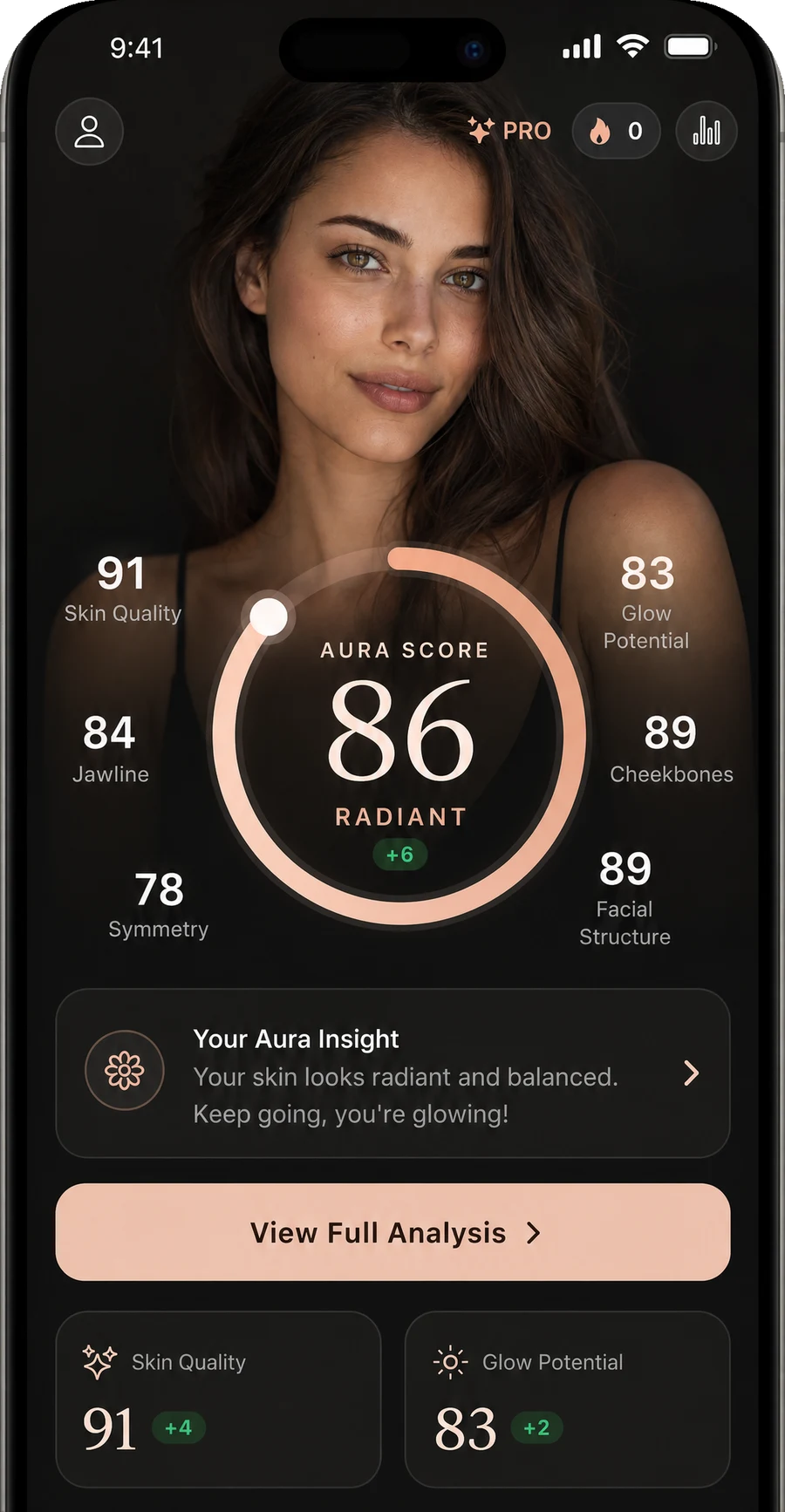
Faster than guessing in the mirror
A consistent baseline beats doomscrolling “looksmax” opinions with no measurement behind them.
Selfie → full analysis
Take one selfie. GlowUp analyses facial structure, contour, symmetry, skin quality, and glow potential in seconds — then shows what to work on.
A consistent baseline beats doomscrolling “looksmax” opinions with no measurement behind them.
Six category scores, a plain-language summary, and ranked improvement areas instead of a black-box rating.
Scan skincare barcodes against your profile after you know where your skin actually stands.
The analyser is only as consistent as the photo you feed it, so a little discipline up front pays off every time you rescan. Face the camera straight on, at eye level; tilting the phone down shortens the lower face and tilting it up stretches it, and both will move your contour reading for reasons that have nothing to do with you. Use soft, even light — a window in daytime works better than overhead bathroom LEDs, which carve shadows that the model can read as texture. Keep hair off the forehead and jaw so the landmarks it measures are actually visible. Drop the beauty filters entirely: a smoothed selfie produces a skin score for the filter, not for your skin, and the routine the app generates from it will be aimed at the wrong problem. None of this needs to be perfect. It needs to be repeatable, because the value of analysis is in the comparison between scans, and comparisons only mean something when the conditions match.
From one selfie, GlowUp returns six scores: an overall Aura Score on a 0–100 scale, plus Skin Quality, Glow Potential, Contour (labelled Jawline in parts of the app), Facial Structure (labelled Cheekbones in places), and Symmetry. That structure matters because different dimensions respond to different things — skin responds to routine and sleep within weeks, contour shifts with body composition and grooming, and structure is largely what it is. Alongside the scores you get a short written summary, three to five named strengths, and a set of improvement areas ranked HIGH, MEDIUM, or LOW, so the output reads like an assessment with priorities rather than a rating. The app then turns those priorities into a five-to-eight-step routine split across morning and evening, tuned to the skin type you picked during onboarding.
A face analyser that stops at the result screen is a toy. GlowUp is designed so the scan feeds everything that follows. The generated routine becomes a daily checklist with streak tracking, because the boring, repeated days are what move a skin score, not the day you bought a new serum. The barcode ingredient scanner checks products against your skin profile and flags each ingredient Safe, Caution, or Avoid with an overall verdict, which turns the analysis into better buying decisions. The AI Skin Coach chat knows your latest scan, so questions like “why is my skin quality lower than I expected?” get answers grounded in your own result rather than generic advice. And the progress chart, scan timeline, and before/after compare give the whole thing a memory. Analysis tells you where you are; the rest of the app is for going somewhere with it.
It is worth being clear about limits. GlowUp is a self-improvement tool, not a diagnostic one — it scores how your face and skin present in a photo, and it does not detect or diagnose any medical condition. If you have persistent acne, a mole that has changed, sudden skin changes, or you are on medication that affects your skin, that is a conversation for a doctor or dermatologist, not an app. The analysis also cannot see through a bad photo: a blurry, filtered, or badly lit selfie produces scores that reflect the photo more than the face. And it will not promise transformation on a deadline. What it can do reliably is give you a consistent, private baseline, show you which dimension has the most headroom, and measure whether the things you are doing are actually working.
Face analysis only works if you are willing to give it an honest, unfiltered photo, and that is a reasonable thing to hesitate over. GlowUp’s answer is simple: photos are never stored, shared, or used for AI training, and each one is deleted right after your results are created. The app keeps the analysis — your scores, summary, strengths, and routine — not the image. There is no social feed and no public profile; nothing you scan is visible to anyone else. Your history exists so that you can compare yourself against yourself, which is the only comparison that ever helped anyone improve.
Scans are designed for diverse skin tones. Good lighting still matters more than any model claim — even, front-facing light gives the fairest reading regardless of complexion.
Yes. There is no feed and nothing is posted anywhere. Results stay in your account, and your photo itself is deleted right after results are created.
Onboarding asks your skin type — Normal, Dry, Oily, Combination, or Sensitive — and your gender. The skin type shapes your generated routine and how the ingredient scanner rates products for you.
Seconds. You take one selfie, the analysis runs, and you get the full result: six scores, a summary, strengths, ranked improvement areas, and a generated AM/PM routine.
No — there is a deliberate rescan cooldown. Skin barely changes in a day, so back-to-back scans would only measure lighting noise. The app asks you to wait so your history stays meaningful.
Free to start. Scan once, read the six-score breakdown, track what improves.
Free download on iOS and Android.
