


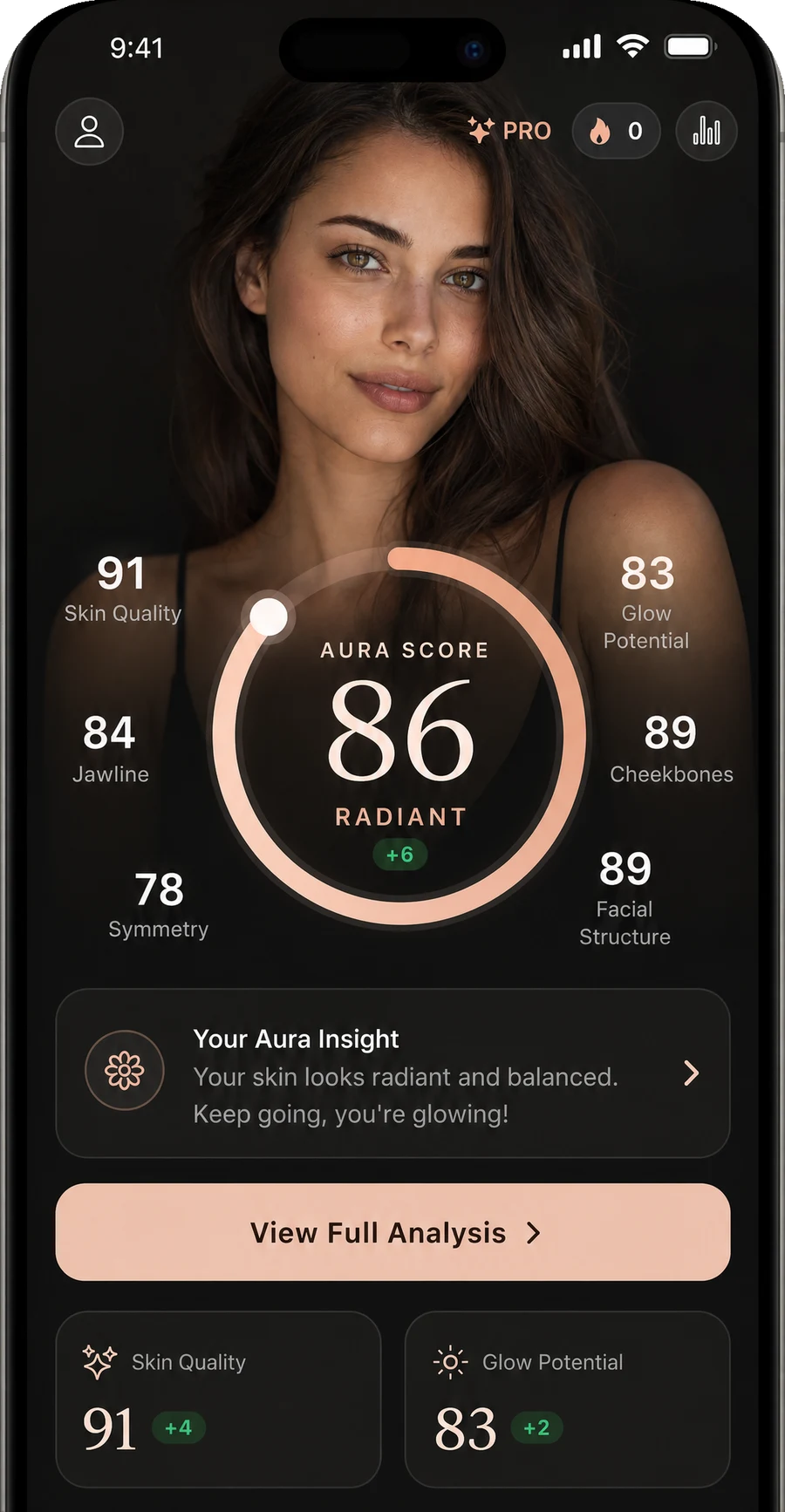
Attractiveness is multi-factor
Skin clarity can move perceived attractiveness faster than obsessing over bone structure.
Multi-factor rating
GlowUp refuses one-number humiliation. You get an Aura Score plus the dimensions that actually respond to sleep, skincare, and grooming.
Skin clarity can move perceived attractiveness faster than obsessing over bone structure.
Score → routine → product choices → rescan is the product, not the rating alone.
The healthiest way to use any attractiveness-adjacent score is the way athletes use bodyweight or bar speed: directional feedback under controlled conditions, never identity. A number measured this morning, in this light, at this angle, is a data point. A number tracked for three months under a consistent protocol is information. GlowUp is structured to push you towards the second reading. Every scan returns the overall Aura Score plus five dimension scores, a written summary, three to five strengths, and improvement areas ranked HIGH, MEDIUM, and LOW — a dashboard, with the overall number as the headline and the dimensions as the workload underneath. The rescan cooldown stops you refreshing the number compulsively, and the progress chart reframes the question from “what am I rated?” to “which direction am I moving?” One of those questions has a useful answer.
GlowUp scores six things from a single selfie. The Aura Score is the overall 0–100 headline. Beneath it sit five dimensions: Skin Quality, which reads clarity, texture, and evenness and is usually the fastest to respond to effort; Glow Potential, an estimate of how much headroom your current presentation leaves; Contour, shown as Jawline in parts of the app, covering how defined the lower face reads; Facial Structure, shown as Cheekbones in places, reflecting the slower-moving frame; and Symmetry, a measure of left-right balance. The split exists because “attractiveness” as a single number hides everything you would need to know to act. Two people with the same overall score might have opposite situations — one with strong structure and neglected skin, one with excellent skin on a softer frame — and they should be doing completely different things next. The dimensions are what make the difference visible.
First scans in GlowUp typically land in the mid-50s to mid-60s, and this is a design decision worth understanding before you take one. The 0–100 scale carries named bands: below 65 is Building, 65 and above Balanced, 80 and above Glowing, 85 and above Radiant, 90 and above Excellent. A first result in the Building or Balanced range is the intended starting point, not an insult — a rating app that opens with flattery has nothing left to offer you a month later, and no honest reason for its routine to exist. GlowUp’s premise is that the number should be able to move when you do the work, which requires the baseline to sit where movement is possible. If a mid-50s number would genuinely upset you rather than motivate you, that is worth knowing about yourself before scanning. The app frames every result with strengths for a reason, but it does not inflate the starting line.
The practical value of a multi-factor attractiveness score is that it tells you where effort pays. Skin quality is the high-leverage dimension for most people: consistent cleansing, moisturising, and sunscreen — the backbone of the five-to-eight-step AM/PM routine the app generates for your skin type — produce visible change on a timescale of weeks, and clear, healthy-looking skin shifts how the whole face reads. Contour responds on a timescale of months through body composition, and within days through grooming choices like beard shape. Sleep shows up in skin and puffiness quickly enough to measure. Structure and symmetry, by contrast, are mostly fixed, which is why the ranked improvement areas will rarely point you there. The supporting tools close the loop: the ingredient scanner rates products Safe, Caution, or Avoid against your profile before you buy, and the AI Skin Coach answers questions with your latest scan already in view.
It is model-based analysis built for self-improvement, not a clinical instrument or a dating-outcome predictor. Its value is consistency: the same analysis applied to comparable photos over time shows you direction.
The bands are 90+ Excellent, 85+ Radiant, 80+ Glowing, 65+ Balanced, and Building below that. But the app is deliberately built around movement between scans rather than a pass/fail threshold — first scans typically start mid-50s to mid-60s by design.
The trainable dimensions can move it: skin quality responds to a consistent routine within weeks, and contour follows body composition and grooming. The app ranks your improvement areas so effort goes where the headroom is.
No. There is no feed and no public ranking. Results stay in your account, and the photo behind them is deleted right after results are created — never stored, shared, or used for AI training.
Free to start. Scan once, read the six-score breakdown, track what improves.
Free download on iOS and Android.
