

Harmony is a mix, not a myth
See how dimensions sit together instead of chasing a single sacred percentage.
Harmony as a dashboard
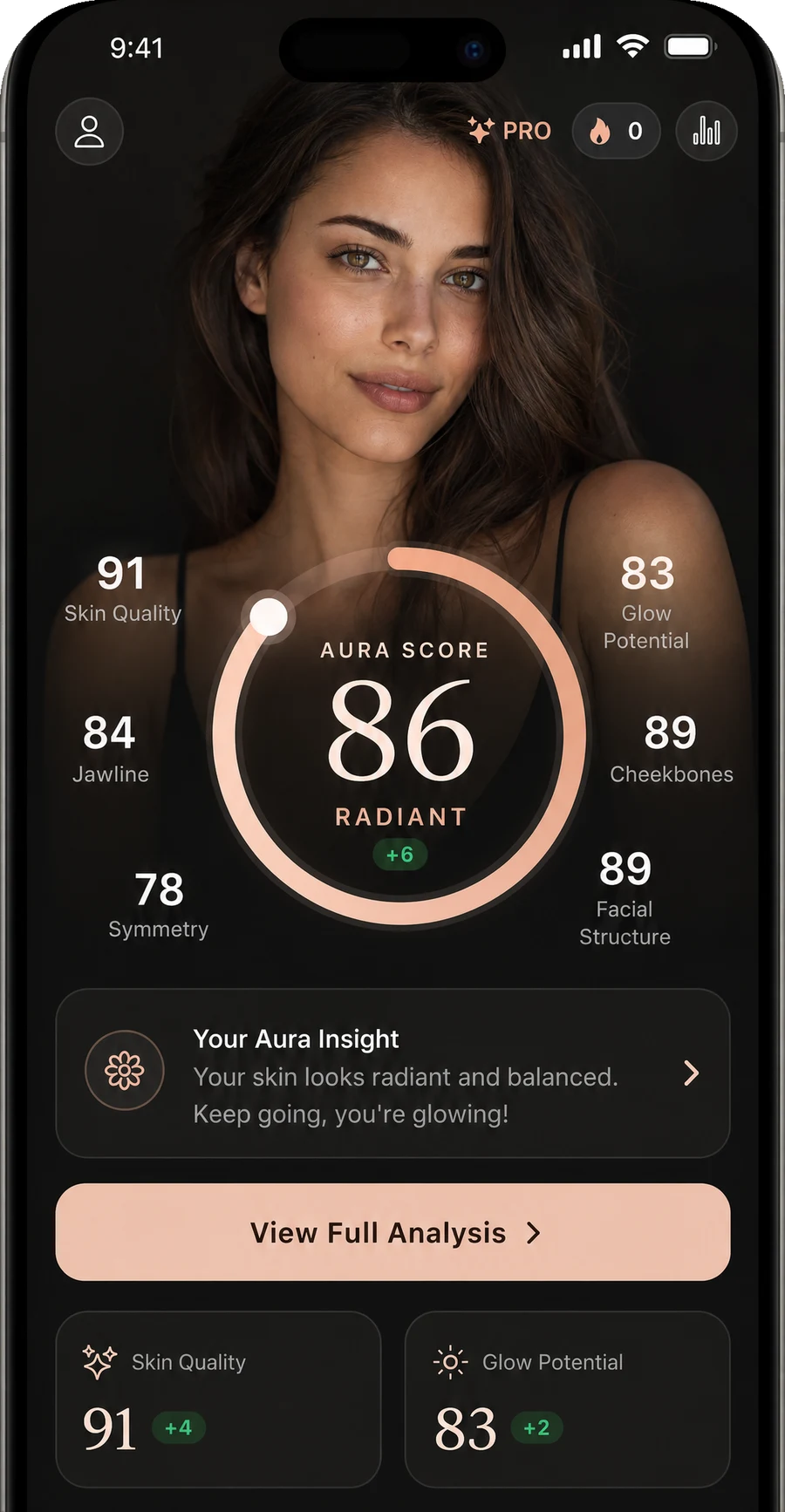
Harmony is not one mystical ratio. GlowUp shows how structure, contour, symmetry, and skin work together — and which lever is worth your next month.
See how dimensions sit together instead of chasing a single sacred percentage.
Ranked improvement areas tell you whether skin or presentation is the real gap.
Rescans show whether your “harmony” reading improved for reasons you can name.
In everyday language, facial harmony means features that feel balanced together — nothing loudly fighting the rest of the face. When friends say a face looks harmonious, they usually mean nothing is loudly fighting the rest: skin does not distract, the lower face does not feel randomly soft or harsh relative to the midface, and left-right balance is close enough that you stop noticing it. That everyday sense is worth keeping. It is also broader than any single ratio. Skin texture, grooming, and lighting change harmony impressions as much as bone geometry does — which is why a tired, broken-out day and a slept, clear day of the same skull feel different in photos. In looksmax and aesthetics circles, the word gets loaded with ratios, thirds, fifths, and golden-section overlays. Some of those ideas come from art and research; many consumer apps oversell them as precise destiny. GlowUp takes a practical stance. It does not ship a single “harmony percentage” derived from golden-ratio claims. It scores the parts of presentation that compose how harmonious a face reads in a photo: Facial Structure, Contour, Symmetry, Skin Quality, and Glow Potential under an overall Aura Score.
Golden-ratio face tests detect landmarks, compute proportions, and emit a confident percentage. The maths constant is real; the leap to “your attractiveness equals distance from 1.618” is folklore layered on selective celebrity overlays. Different calculators disagree on the same selfie because recipes and photo conditions differ. Use them as toys if you like. Do not let a phi percentage postpone sleep, sunscreen, or a haircut — the levers that change how harmonious you look this month. GlowUp’s golden-ratio face test page covers the myth in more depth; this score page owns the broader facial-harmony query.
GlowUp does not ship a separate harmony percentage. Read harmony as a composition of scores. Structure and Contour are a pair: structure is the slower frame, contour is how defined that frame currently looks. A big gap often means presentation headroom (leanness, grooming, sleep, water noise) rather than a “harmony failure.” Symmetry captures left-right balance; mild asymmetry is normal, and photo tilt creates false alarms. Skin Quality changes how polished the whole face reads — clear, even skin makes the same structure look more harmonious in ordinary light. Glow Potential estimates whether the trainable mix still has upside. Ranked HIGH / MEDIUM / LOW priorities tell you which part of the composition to work on first so “fix harmony” becomes a concrete project.
Baseline under protocol light. If skin is HIGH, run the generated routine with streaks unbroken and barcode-check any new product. If contour is the gap under solid structure, set a monthly contour check and align training or diet; fix beard and hair so landmarks read cleanly. Grooming — hair off landmarks, beard lines, brows — changes how balance reads within days. Body composition and sleep shift contour over months and mornings respectively. Do not stack five experiments. Rescan once at the end under the same photo protocol. If the Aura Score and the weak dimension both moved, harmony improved for reasons you can name. If not, change one variable next block — still better than redrawing grids on your forehead.
No app sees depth perfectly from a 2D selfie. Lighting and angle dominate short-term swings. GlowUp is not a clinical cephalometric analysis and does not replace a clinician for sudden facial changes. Use harmony language as a way to understand balance across scores, not as a promise that your face will converge on a textbook diagram.
It gives an Aura Score and five dimensions that together describe balance and presentation. There is no separate golden-ratio harmony badge.
Symmetry is one ingredient. Harmony in practice also involves how structure, contour, and skin read together.
It can improve how harmonious your face looks by raising Skin Quality — clarity and evenness change presentation even when bone structure does not.
See the Symmetry and Facial Structure score pages, plus the golden-ratio face test page if you landed here from a phi-grid search.
Free to start. Scan once, read the six-score breakdown, track what improves.
Free download on iOS and Android.
