


Visible in weeks
Barrier repair and consistency show up sooner than structural changes.
Skin-first scoring
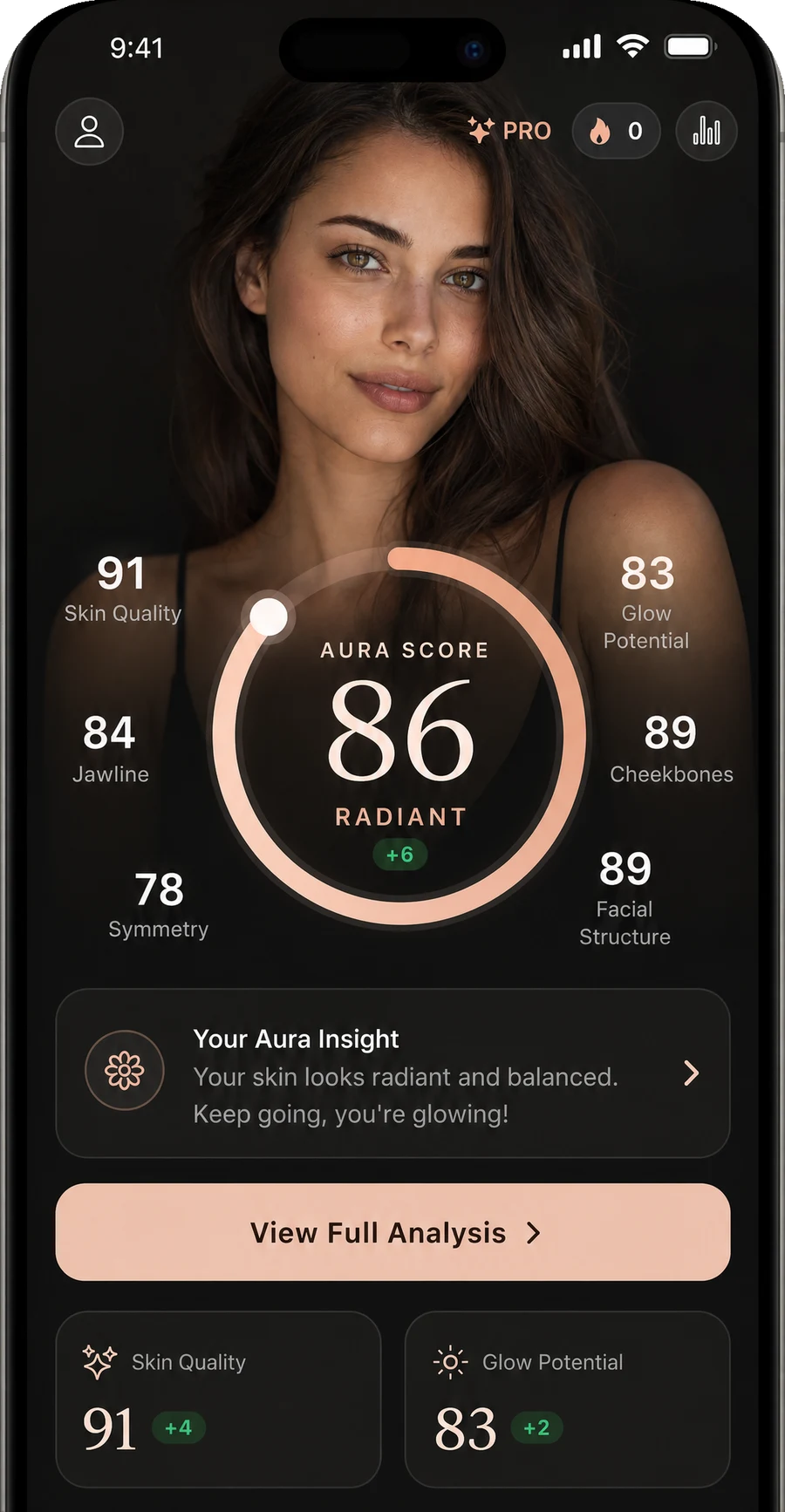
Skin quality is the fastest glow lever for most people. Measure it, pick products that match, and watch the score trend.
Barrier repair and consistency show up sooner than structural changes.
Safe / Caution / Avoid ingredient flags help you skip products that fight your skin type.
A skin quality score is only as good as the photo behind it, so the baseline deserves ten minutes of care. Scan bare-faced: makeup smooths texture and evens tone, which is its whole job, and a scan through it scores the makeup rather than the skin. Use consistent, even light — daylight from a window beats bathroom LEDs, which exaggerate pores and shadows — and scan at roughly the same time of day when you can, since skin looks different at 7am than after a long day. Do not pick your best-ever skin day or your worst; an ordinary day makes the most honest starting point. This is the discipline that later lets you say “the new routine moved my score” with a straight face. Vibes and TikTok testimonials cannot tell you whether a serum is working on your face. A controlled baseline and a four-week rescan can.
During onboarding, GlowUp asks your skin type — Normal, Dry, Oily, Combination, or Sensitive — and that choice runs through everything the app does with your scan. The generated routine of five to eight steps, split into morning and evening, is built for that skin type: what suits oily skin can strip dry skin, and what comforts dry skin can clog oily skin, so a one-size routine is worse than none. The barcode ingredient scanner uses the same profile, rating each ingredient in a product Safe, Caution, or Avoid for you specifically, with an overall verdict on the product — the same bottle can reasonably score differently for a sensitive-skinned user than for an oily-skinned one. If you are not sure of your type, the honest tells are how your skin feels an hour after cleansing with nothing applied: tight suggests dry, shiny suggests oily, both in different zones suggests combination, and easily irritated suggests sensitive.
The skin quality score is designed to start a loop, not end one. Your scan result names skin-related improvement areas and ranks them HIGH, MEDIUM, or LOW, and the generated AM/PM routine addresses them in order. The routine tracker then turns it into a daily practice with streaks, which sounds like a gimmick until you accept the central truth of skincare: consistency beats product quality almost every time, and the difference between a routine done daily and one done when remembered is the difference between a moving score and a flat one. When you are tempted by a new product, scan its barcode first and let the Safe / Caution / Avoid flags and overall verdict argue with the marketing. Then rescan on a three-to-four-week cadence — the app’s cooldown discourages anything more frequent — and read the slope on your progress chart rather than any single result. That slope is the proof most people never collect.
Numbers tell you what; they are quieter about why. The AI Skin Coach is a chat inside GlowUp that already knows your latest scan, so you can ask the questions a result naturally raises — why skin quality came in lower than expected, which of your ranked improvement areas to take on first, how to sequence the steps in your generated routine, or whether a product the scanner flagged as Caution is worth the risk for your skin type. Because the coach has your actual result in context, the answers stay grounded in your situation rather than generic skincare content. One boundary it keeps, and you should too: it is not a doctor. Persistent or painful acne, sudden changes in your skin, reactions to a product, or anything involving medication belongs with a GP or dermatologist. The coach helps you work the self-care layer properly; it does not replace the medical one.
It can mask texture in either direction, which makes the score less meaningful rather than simply lower. Use bare-face scans when you care about true skin quality trends, and keep conditions consistent scan to scan.
Skin is the fastest-moving dimension, but it still works in weeks, not days. A consistent routine typically needs three to four weeks before the trend is readable — which is why the app encourages that rescan cadence and enforces a cooldown between scans.
Then see a doctor or dermatologist — persistent acne, sudden changes, painful reactions, or anything tied to medication is outside what a scoring app should advise on. GlowUp tracks presentation and supports habits; it does not diagnose or treat.
It rates each ingredient Safe, Caution, or Avoid against the skin profile you set during onboarding — Normal, Dry, Oily, Combination, or Sensitive — and gives the product an overall verdict, so the judgement is relative to your skin, not generic.
No. Photos are deleted right after your results are created, and they are never stored, shared, or used for AI training. Your scores and routine history are what persist.
Free to start. Scan once, read the six-score breakdown, track what improves.
Free download on iOS and Android.
